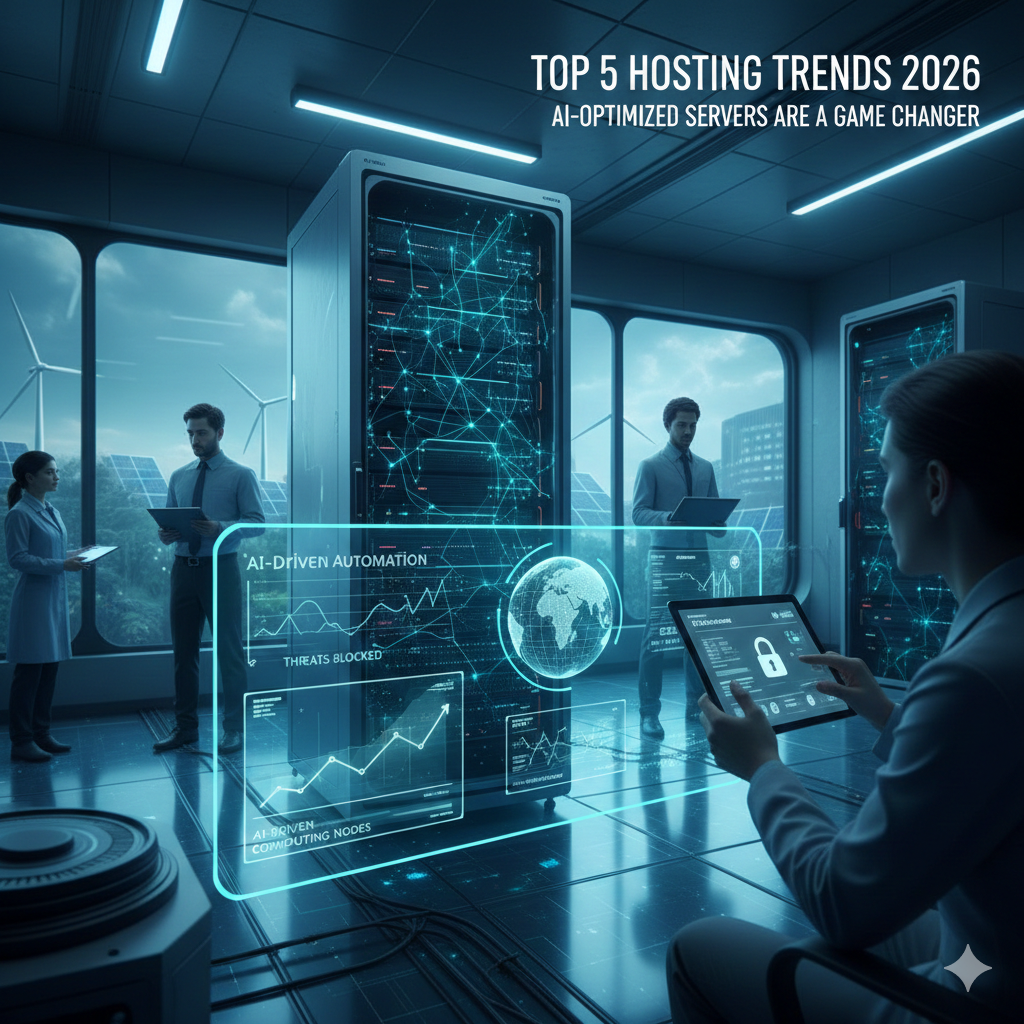
The web hosting landscape has evolved far beyond mere storage and uptime. In 2026, the rise of complex web applications and the integration of Artificial Intelligence (AI) have forced hosting providers to rethink infrastructure. If you are still running on a traditional legacy server, you might be falling behind.
Here are the top 5 hosting trends dominating 2026 and why AI-Optimized Servers are the ultimate game changer.
1. AI-Optimized Hosting Architecture
Traditional servers allocate resources based on static limits. In 2026, AI-driven hosting uses machine learning to predict traffic spikes before they happen.
- Why it’s a Game Changer: These servers analyze visitor patterns in real-time, automatically scaling CPU and RAM resources within milliseconds. This ensures that a viral post or a sudden government announcement doesn’t crash your web application.
2. Edge Computing & Decentralized Hosting
Latency is the enemy of modern user experience. Hosting is moving away from centralized data centers toward the Edge.
- The Trend: By processing data closer to the user, Edge computing reduces “round-trip” time for data. In 2026, hosting your PHP/MySQL applications at the edge means your site loads instantly, whether the user is in Jakarta or New York.
3. Sustainable & “Green” Data Centers
With global regulations tightening around carbon footprints, Eco-friendly hosting is no longer optional—it’s a requirement for corporate and eGovernment compliance.
- The Trend: Top-tier providers are now utilizing 100% renewable energy and liquid cooling technologies that reduce power consumption by 40% compared to traditional air-cooled fans.
4. Enhanced Security with AI Threat Detection
Cyber threats in 2026 are powered by bots that can bypass old-school firewalls. Modern hosting now includes AI-powered Security Operation Centers (SOC).
- The Benefit: These systems can distinguish between a real human user and a malicious AI bot attempting a brute-force or SQL injection attack, blocking threats with 99.9% accuracy before they reach your database.
5. Serverless & Headless Compatibility
The “monolithic” approach is fading. Modern hosting providers are optimizing for Serverless functions and Headless CMS setups (like Headless WordPress).
- The Trend: You only pay for the execution time of your code rather than an idle server. This modular approach makes web applications more flexible, easier to update, and significantly cheaper to maintain at scale.
Why AI-Optimized Servers are the “Ultimate” Shift
In 2012, we worried about disk space. In 2026, we worry about intelligence. AI-Optimized servers aren’t just “hosting” your files; they are actively managing them.
Technical Insight: For developers working with PHP 8.4+ and MySQL, AI optimization helps in query tuning—automatically identifying slow database calls and suggesting index improvements to keep the application running at peak performance.
Who is Leading the AI Hosting Revolution in 2026?
If you are looking to migrate to an AI-optimized environment, here are the top providers currently leading the 2026 trends:
- Google Cloud Platform (GCP): Best for AI-driven autoscaling. Their Vertex AI integration allows developers to build and host apps with built-in machine learning capabilities.
- SiteGround: Known for their AI-powered Bot Filter. They are pioneers in using AI to block millions of security threats daily before they even hit your WordPress install.
- Kinsta: The leader in Managed Hosting on the Edge. By using Google Cloud’s Premium Tier network and Cloudflare integration, they ensure your web applications are “Edge-ready.”
- DigitalOcean: The go-to for Serverless and Scalable Databases. Their “App Platform” is perfect for modernizing legacy PHP/MySQL applications into modular microservices.
- Hostinger: Excellent for AI Website Creation and Optimization at an affordable price point, making high-end tech accessible for smaller businesses.
Conclusion: Is Your Host Ready for 2026?
The transition to AI-driven hosting is more than just a trend; it is a necessity for anyone managing high-traffic web applications or sensitive eGovernment data. Moving to an AI-optimized environment ensures security, scalability, and sustainability.

